Analysis
What do the data actually mean for people's lives?
This is where the project's own arguments live: peer-reviewed papers, working papers, policy briefs and commentary from affiliated scholars, whatever their home institution.
On this page
Clearing Encampments or Resolving Homelessness?
PATHS, October 2026 · Chien, Kuhn, Henwood and colleagues
Los Angeles relies on two main responses to encampments. Conventional clearances, commonly called sweeps, direct people to move and may involve sanitation workers, law enforcement, citations, arrests, and the removal of personal belongings. Encampment Resolution Programs, or ERPs, such as the City's Inside Safe and the County's Pathway Home, are intended to offer a more service oriented alternative.
This report examines how these approaches work in practice, whom they reach, and what happens to the people affected. It draws on roughly 17,000 monthly surveys completed by 1,600 participants in the PATHS study between April 2023 and July 2026, alongside first person accounts developed through WeSearch, a poor people led research practice.
At a glance
- of respondents were swept in any given month
- 1 in 4of respondents were swept in any given month
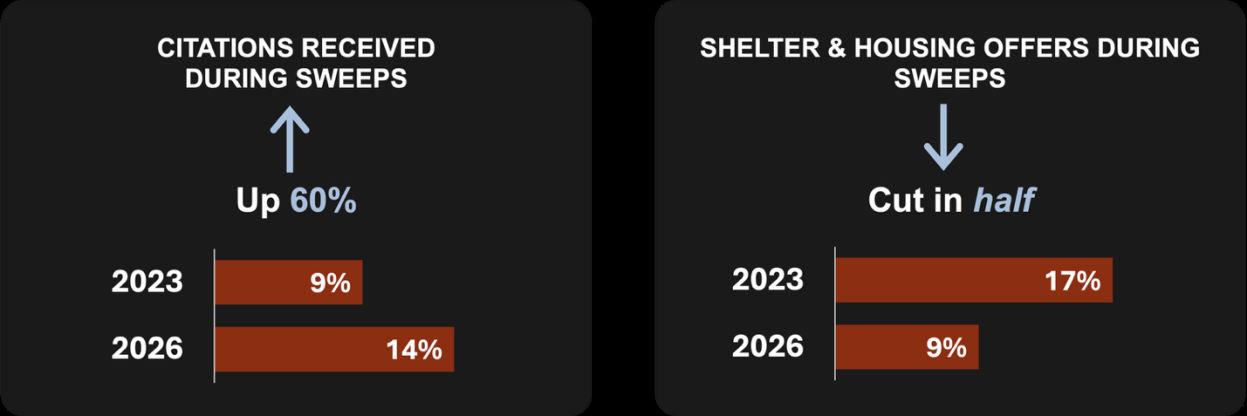
- of sweeps came with a shelter or housing offer in 2026, down from 17% in 2023
- 9%of sweeps came with a shelter or housing offer in 2026, down from 17% in 2023
- of the cohort was invited to an ERP, compared 60% who were swept
- 22%of the cohort was invited to an ERP, compared 60% who were swept
- shelter retention for ERPs as for sweeps, per person reached
- 12xshelter retention for ERPs as for sweeps, per person reached
What the study found
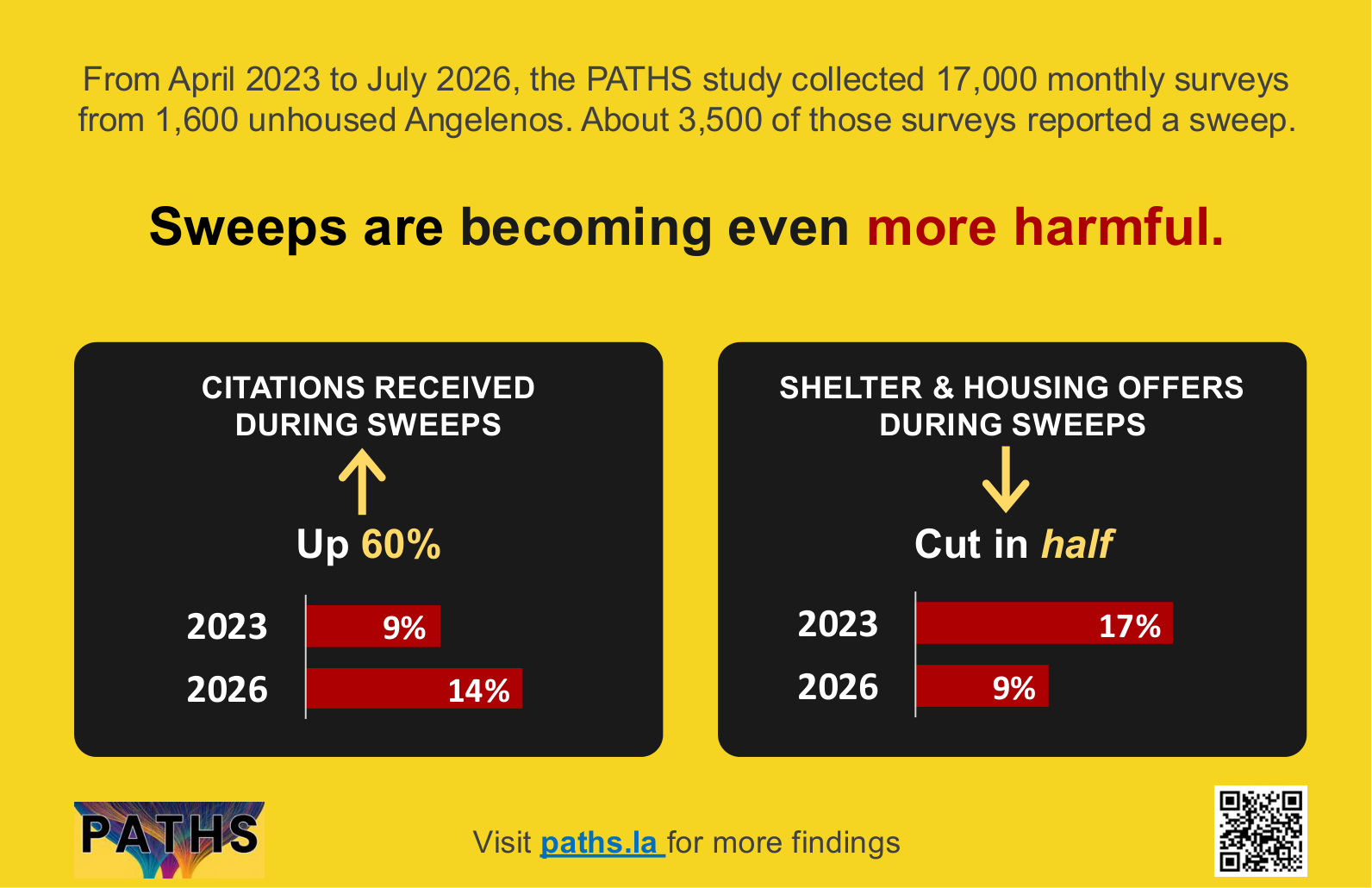
**Sweeps are a routine experience for unsheltered Angelenos, but they rarely provide a pathway indoors and are becoming more punitive.** On average one in four respondents reported a sweep in any given month. Between 2023 and 2026 the share of sweeps involving a shelter or housing offer fell by nearly half, while the share resulting in a citation rose by almost 60%.
**The constraint is the short supply of meaningful offers, not an unwillingness to accept help.** Two thirds of respondents who received an offer during a sweep accepted it, reaching 78% for motel or hotel placements and 80% for bridge or transitional housing. Even congregate shelter, which very few named as a preferred option, was accepted by nearly half of those offered it.
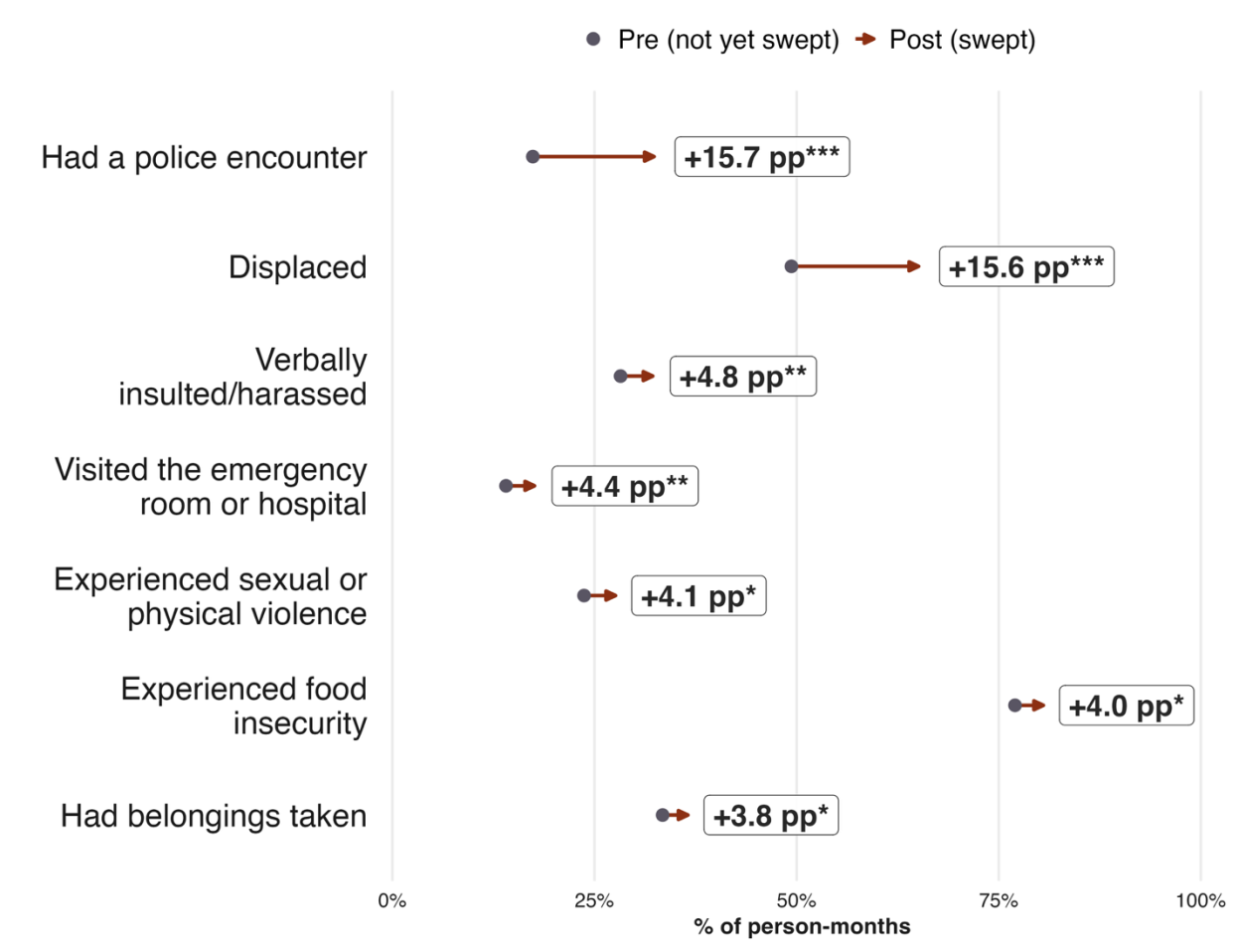
**The consequences extend well beyond being told to move.** Sweep exposure was associated with increases in forced displacement, police contact, property loss, food insecurity, emergency department use, harassment, physical or sexual violence, poorer self rated physical health, and greater psychological distress.
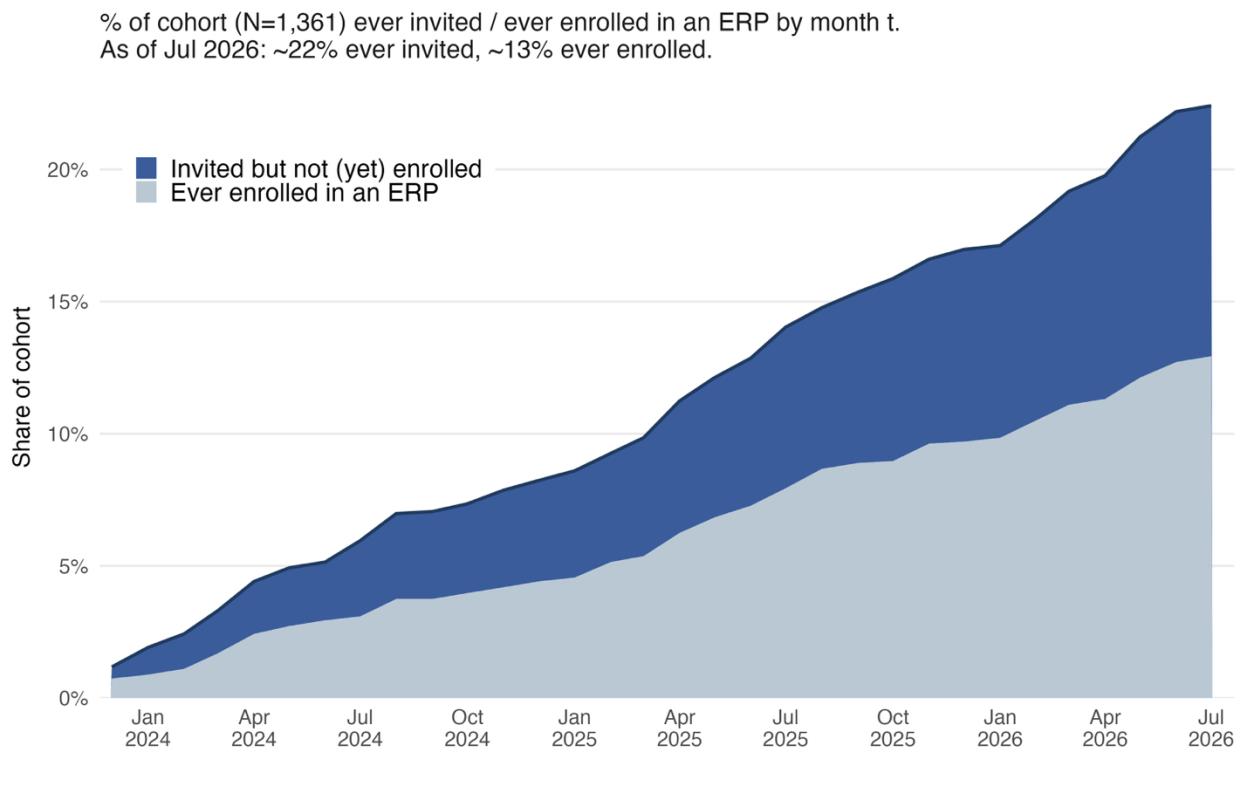
**ERPs perform substantially better than sweeps in shelter yield, retention and service access, but their reach is limited.** From December 2023 through July 2026, 22% of the cohort reported an ERP invitation, while 60% experienced a sweep. Per person reached, ERPs produced roughly twelve times the shelter retention rate of sweeps.
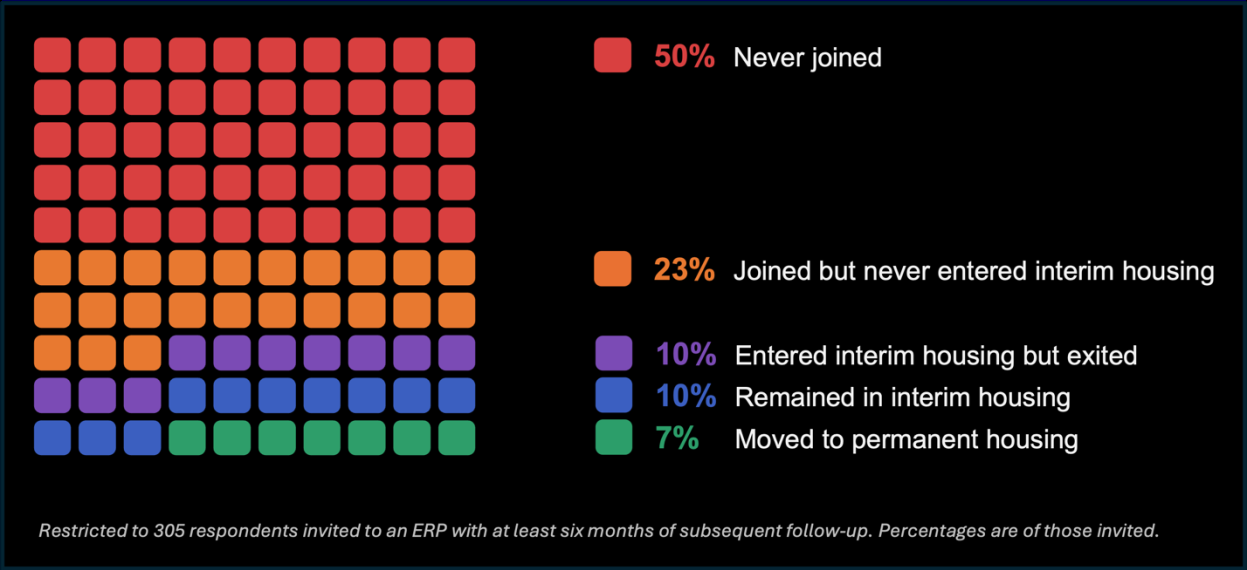
**Better than a sweep is not the same as resolving homelessness.** Among people invited to an ERP and followed for six months, half never joined and a further 23% joined but never entered interim housing. Of the roughly one quarter who did get indoors, 10% had already exited by six months.
Sweeps and policing
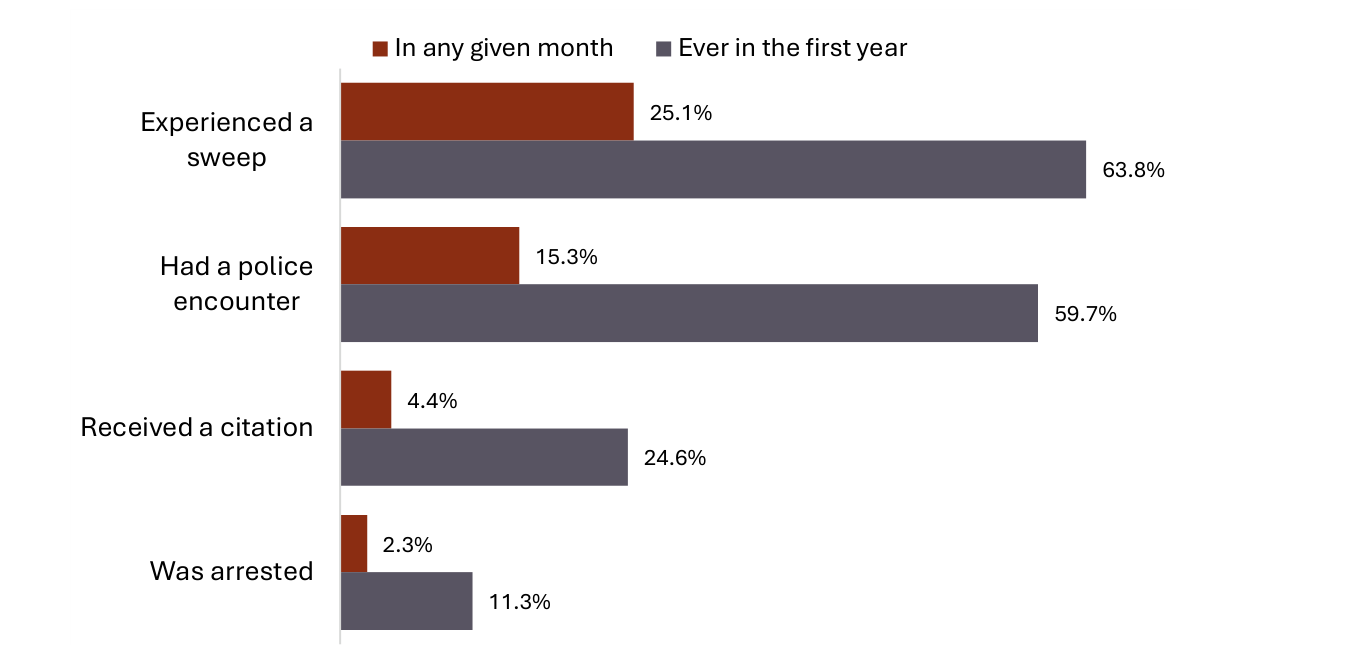
From April 2023 through July 2026 an average of one in four respondents reported a sweep in any given month. Almost two thirds of returning respondents were swept in their first year in the study, and over half experienced at least two sweeps.
Six in ten reported police contact in their first year. A quarter received a citation and more than one in ten were arrested. By comparison the annual arrest rate of US adults is about 5 in 1,000, making PATHS respondents more than 20 times more likely to report an arrest.
Sweeps rarely include an offer of shelter. Just one in nine, about 11%, was associated with a shelter or housing offer. The rate at which sweeps involved an offer fell by half, from about 17% in 2023 to about 9% in 2026, while the share leading to a citation rose from about 9% to about 14%. **In 2026 a sweep is far more likely to lead to a citation than to a shelter offer.**
Across all sweeps, just 4% resulted in a meaningful shelter stay. Among those who received no offer, the share who stayed put fell from 39% to 27% while the share who temporarily left and returned rose from 32% to 47%. Only one in four move and stay away.
I have dealt with countless sweeps. In those I have lost a home. I have lost my favourite trench coat, that could keep you warm on the coldest night. I have lost friends and their memorials. I have lost stability in the aftermath of sweeps’ violence because the trauma doesn’t disappear when cops and sanitation do, it moves through us into each other.
Encampment Resolution Programs
ERPs are pitched as a solution to unsheltered homelessness as a whole, but in practice they target large encampments. The intensity of outreach and the limited availability of hotel rooms have held the total to 136 operations in Inside Safe and 77 in Pathway Home since they launched in December 2022 and August 2023.
Among everyone ever invited to an ERP, 305 people, 76% had also been swept at some point and 53% experienced a sweep in the very same survey month as an invitation.
Following each respondent for six months from their first ERP invitation or first sweep, the two pathways diverge sharply at the point where assistance is offered. Of 305 people invited to an ERP, 152 (50%) enrolled or accepted an offer, 79 (26%) were sheltered or housed within two months, and 50 (16%) remained sheltered or housed at last follow up. Of 744 people swept without a concurrent invitation, 30 (4%) accepted an offer, 21 (3%) were sheltered within two months, and 10 (1.3%) remained indoors.
**ERPs deliver roughly twelve times the shelter yield of sweeps per person reached, and still result in an enduring placement for fewer than 1 in 25 respondents overall.** Just 23 enrollees reached permanent housing within six months: 7.5% of those invited, and 1.7% of the full sample.
It was cool to take showers and be able to have your own space for a second. But it comes to a certain level where okay, that’s cool, but is it worth the lack of visitation from my family or friends, or being able to cook for myself, or being able to do anything that I’m normally naturally doing to just, you know, be myself?
What the findings mean
If the goal was to design an encampment operation that fares better than a conventional sweep, ERPs appear to accomplish it. They are more likely to bring people indoors, more likely to connect them with services, and less likely to expose them to enforcement, displacement and property loss.
But ERPs are costly, resource intensive operations that reach a relatively small share of the unsheltered population, and their apparent success depends heavily on which outcomes are measured and which people remain in the denominator. A retention rate of about 60% among those who enter interim housing may appear encouraging, but it excludes people who were never invited, those who did not enroll, those who enrolled but never received a placement, and those who returned outside. **These groups constitute most of the people encountered through the intervention.**
An operation may successfully clear a location while leaving most of the people who lived there homeless and increasingly scattered. **Site clearance, interim placement, continued residence indoors, and entry into permanent housing are different outcomes and should be reported as such.**
Implications for Los Angeles
With approximately 21 months remaining before the Games, improving ERPs will be important, but it will not be enough. The findings point to three priorities.
**1. Expand access to permanent housing within the remaining time.** Los Angeles cannot build all the affordable housing it needs before the Games, but it can examine whether additional housing can be secured through rental subsidies, flexible financial assistance, master leasing, property acquisition or conversion, and stronger incentives for landlords accepting tenants with vouchers.
**2. Strengthen the pathway from outreach to permanent housing.** ERPs need multiple placement options, interim settings that preserve greater autonomy, and continued engagement when an initial offer does not result in placement. People may experience repeated sweeps, but ERP invitations are much less likely to recur.
**3. Develop safe options for people who cannot be placed indoors.** Most people living outside are never reached by ERPs or do not get placed in interim housing. Repeatedly directing people to another sidewalk merely transfers the problem. Los Angeles should consider safe parking and sanctioned camping programs that provide sanitation, water, storage, health care, outreach and continuing pathways toward housing.
This report establishes a baseline for continued monitoring of sweeps, policing, ERP reach and housing outcomes as Los Angeles approaches 2028. Success cannot be measured solely by the disappearance of an encampment. It must account for everyone affected by an operation. Where did people go? Are they safer? Do they remain connected to assistance? Are they closer to permanent housing, or are they simply waiting to be moved again?
**Until Los Angeles can answer those questions, encampments may be cleared, but they cannot credibly be called resolved.**
Earlier analysis
Previously published on this page, and kept here in full.

Excelling for the 2028 Olympics
Restoring, Not Displacing, LA’s Unsheltered Residents
Contents
Executive Summary
Los Angeles has four years to make inroads on the largest population of unsheltered people in the U.S. If we fail, 2028 is likely to be a disaster for unhoused people and LA’s reputation.
Lack of income and the high cost of housing cause homelessness. The median monthly income of unsheltered individuals is $387 a month.
Sixty-one percent of all unsheltered working-age homeless individuals are engaged in work activities. This entails looking for a job much more often than having a job, but the motivation of homeless individuals to support themselves through work is an under-utilized asset for society.
Surprisingly, 70 percent of people sleeping outdoors are homeless for the first time. The age when they become homeless is increasingly young, 25 years old on average. The average amount of time they report being homeless has increased to 1,927 days. During this time, more people are getting criminal records.
Despite all of the calls to increase the supply of rental housing, things are heading in the opposite direction. New building permits in Los Angeles during the first half of 2024 were 10 percent lower than last year and 60 percent lower than five years ago.
Fewer new apartments going up is likely to result in higher rents and more homelessness.
This paper concludes with 10 specific actions that will make Los Angeles a credible host for the 2028 Olympic Games. Foremost is ensuring that individuals have an income through employment or a basic income grant, and ensuring that they are stably housed.
Other priories include identifying and helping high-risk individuals before they become persistently homeless, just eviction policies to protect renters, and record expungement and jail diversion programs.
Olympic Excellence through Restoring Homeless Residents
The Olympic Games demonstrate the discipline, grace and accomplishment of elite athletes. Every host city attempts to mirror the beauty of the games, yet every city is home to ugliness, injustice and inequality as well as beauty, kindness and accomplishment. Los Angeles’ most glaring flaw is the nation’s largest population of unsheltered homeless individuals living on its streets. Masking this tragic flaw by criminalizing and displacing street residents will mark Los Angeles as a city of pretension rather than character. LA has four years to step up to the values in the original Olympic Charter of developing harmony and preserving human dignity.1
The International Olympic Committee calls for upholding human rights in organizing and delivering the Olympic Games, including the safety and well-being of residents.2 This paper identifies who is falling out of housing and onto the streets, why this happens, and concludes with 10 specific actions that will make Los Angeles a credible host for the 2028 games.
LA’s Best Face
Barring truly extraordinary efforts and big changes, the 2028 Olympics are likely to be a disaster for unhoused people and LA’s reputation. The Olympics bring out some of the best in people and the host city. Unfortunately, when it comes to unhoused people, the Olympics often bring out the worst. In the months before the Paris Games, French police rounded up thousands of unhoused people and put them on buses to other parts of the country. A health worker described this as “social cleansing,” saying, “they are hiding misery under the rug.”3
In presenting a sanitized version of themselves, the French were following a precedent set by Los Angeles. Before the 1984 Olympics, the Los Angeles Police Department sterilized the streets, but without the buses or any suggestion from the police as to where homeless people could go to avoid arrest or harassment.4 One suggestion came from the city council member representing downtown, Gilbert Lindsay, who proposed that the city force unhoused people into an LAPD-run “drunk farm” north of Santa Clarita that the city had created in the 1950s to hold up to 1,500 prisoners.
The Supreme Court recently granted cities more power to arrest, cite and fine people who sleep outside in public places — overturning six years of legal protections for homeless residents in California and other western states.5 The prospect of more displacement of homeless individuals is imminent given Governor Newsom’s order to clear encampments and his example, trash bag in hand, personally helping clear a homeless encampment in Los Angeles.6
Displacement is expedient but not effective. Homelessness is not a moral lapse that can be deterred through punishment. It is the outcome of inadequate incomes and unaffordable housing. The solution is to restore individuals’ place in the economy and the housed community.
Mayor Karen Bass has made clear that if she is mayor in 2028, the shameful actions of the spring of 1984 will not be repeated, in part because the very prospect of the “LA Olympics will help be a catalyst to LA finally addressing homelessness in a way that is long-term, that eventually ends street homelessness.”7
2 Excelling for the 2028 Olympics
However, just one day after Mayor Bass’ pledge, the city council authorized traffic officers to enforce parking laws by towing RVs that people live in. These dwellings are the only housing option for people who cannot afford rent and are lucky enough to have an RV. They provide better living quarters than a tent or makeshift shelter. However, the council treated RVs as blight rather than housing. They could have chosen to provide safe parking for these dwelling units of last resort.
Slow Moving Solutions for a Fast Moving Problem
Mayor Bass’ signature “Inside Safe” program has moved entire encampments of unhoused people into “interim housing” in motels with which the City contracts. The County’s “Pathway Home” program operates in a similar fashion. Both programs have “resolved” encampments and moved people into interim housing in motels.
As of July 25, 2024, Pathway Home had “resolved” 17 encampments, removed 422 RV’s, moved 692 individuals into interim housing, and permanently housed 114 people. Data on Inside Safe through December 12, 2023, shows that the program “addressed” 56 encampments, moved 2,870 people indoors (presumably in motels), and moved 609 people into permanent housing.8
When the interim housing is in an Inside Safe or Pathway Home motel room, the cost averages more than $105 per day.9 The tab for the room, which does not include the costs of other services provided, for 262 days is $31,680 per person. If that model were scaled up to serve the estimated 52,365 unsheltered homeless persons in the County, the cost of providing just interim housing while people await permanent housing would be over $1.6 billion. Clearly, the current system is not sustainable. Worse yet, as the 2028 Olympics approach, the motel-based models of Inside Safe and Pathway Home will break down, as motel owners either terminate their agreements or demand rates comparable to what they will be able to charge tourists.
Both City and County officials understand this information. In an interview with KCRW radio, Mayor Bass said, “I am hopeful… that the LA Olympics will help be a catalyst to LA finally addressing homelessness in a way that is long-term, that eventually ends street homelessness.”10 She also recognized that Inside Safe is very expensive, requiring upwards of several thousand dollars a month per motel room, plus the cost of other services. She described the core problem as follows:
“Even if you fast-track something, it still takes months and months. And the expensive thing in a motel versus the expense of being in
some other type of housing is where we need to move to. And so, one thing about the market that is positive is that builders and architects are now coming up with more cost-effective ways of building interim housing that we could put up quicker than we would permanent housing. And so that's what we have to do because the model we're using now is in response to an emergency, but it's far too expensive.”11
If there is a plan to use these cost-effective ways to produce and site even the most modest housing in the next 48 months, it has not been made public. Even if there were a plan, it is not clear that it can be executed before 2028
The Paris Olympics are going to be a tough act for Los Angeles to follow. LA made its fame as Tinseltown, a city of facades. Tens of thousands unsheltered people living on the street are a spoiler. The challenge is for Los Angeles to solve this problem as a city that has come of age by protecting the wellbeing of its residents rather than as a city of facades.
This paper describes the homeless challenge Los Angeles needs to solve before the 2028 Olympics, and how it can solve it with clean hands.
Fifteen-Year Trajectory of Homelessness
The 2024 homeless count may offer some hope. Although the total of 71,201 homeless individuals was almost the same as the 71,320 people in 2023, the number who were unsheltered and sleeping in a place not meant for human habitation was five percent lower than in 2023. This was because the number of homeless people accommodated in shelters and temporary housing was 14 percent higher than in the previous year.
The increase in the number of homeless individuals who were housed may be attributable to the City of Los Angeles’ Inside Safe program and the Department of Veterans Affairs’ One Team initiative.12 The reduction in veteran’s homelessness was primarily driven by using Housing Choice Vouchers to rent apartments from private landlords and providing support services. There are still thousands of units of rental housing available throughout the county, if the supply of vouchers is increased.
Figure 1 shows results over the past 15 years from the point-in-time count conducted by the Los Angeles Homeless Services Authority (LAHSA).13
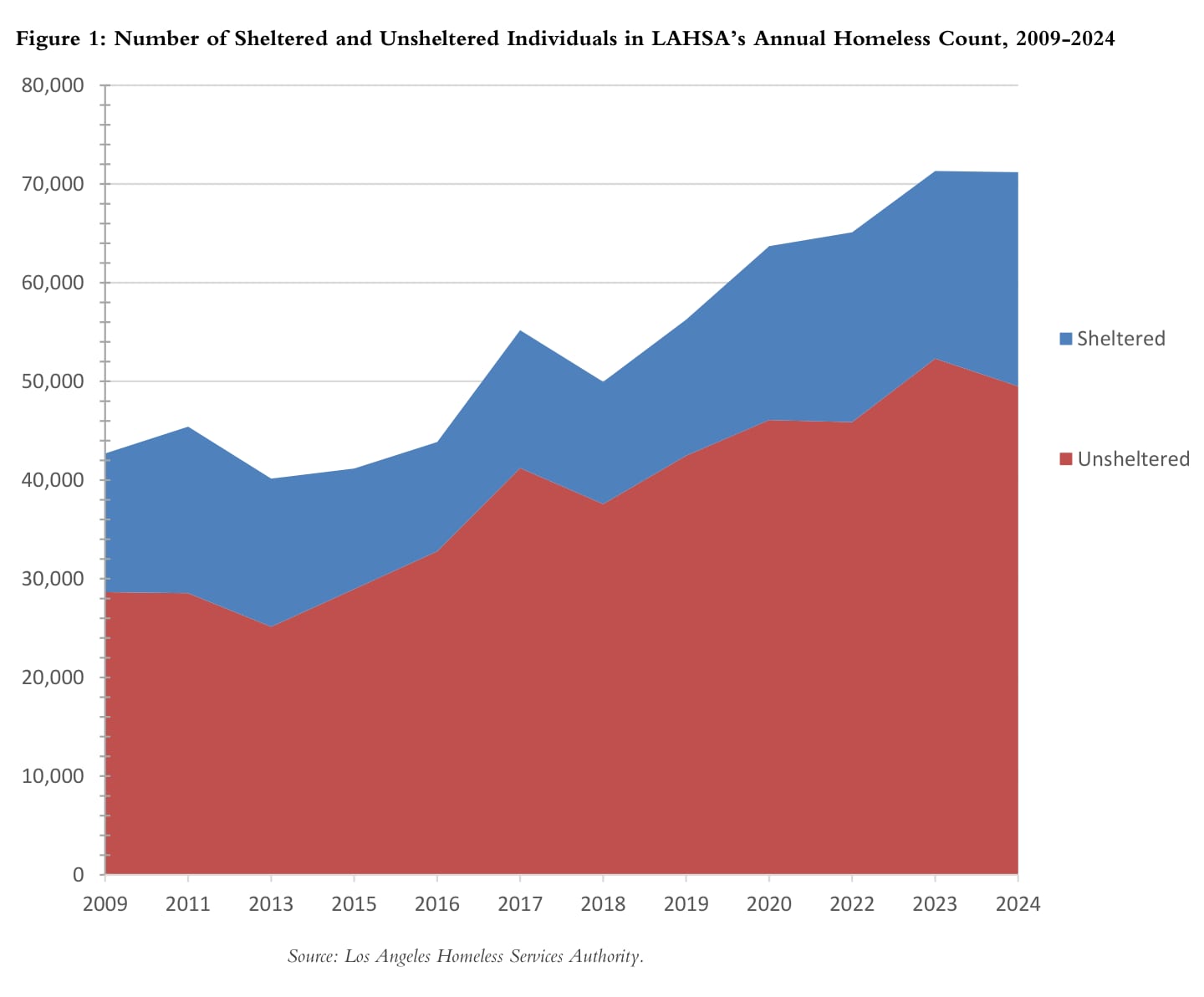
Over the 15 years from 2009 to 2024, homelessness has increased by an average of four percent each year, with similar average increases in the number of both sheltered and unsheltered individuals. This long-term trend is driven by forces that are deeply embedded in Los Angeles’ economy – economic inequality and increasing housing costs.
4 Excelling for the 2028 Olympics
Source: Los Angeles Homeless Services Authority.
Seventy percent of homeless individuals have been unsheltered, on average, throughout these 15 years. They are Los Angeles’ Olympic challenge.
The USC researchers who support the count estimate that there was a margin of error of 1,592 people, or 2.2 percent, in the 2024 homeless count.14 The margin of error is greater than the 119-person decrease from the 2023 homeless count to the 2024 count. Purposeful, restorative intervention is required to turn the tide of homelessness in Los Angeles.
Annual Homeless Population in 2024
Duration of Homelessness
Homelessness is a transient episode in the lives of almost half (46 percent) of people who become homeless. It is the low point in a financial emergency. For others it is many continuing chapters of their lives.
Almost one-third (31 percent) of the point-in-time homeless population is estimated to have been homeless for four months or less during the past year, as shown in Figure 2. Another 15 percent have been homeless for four
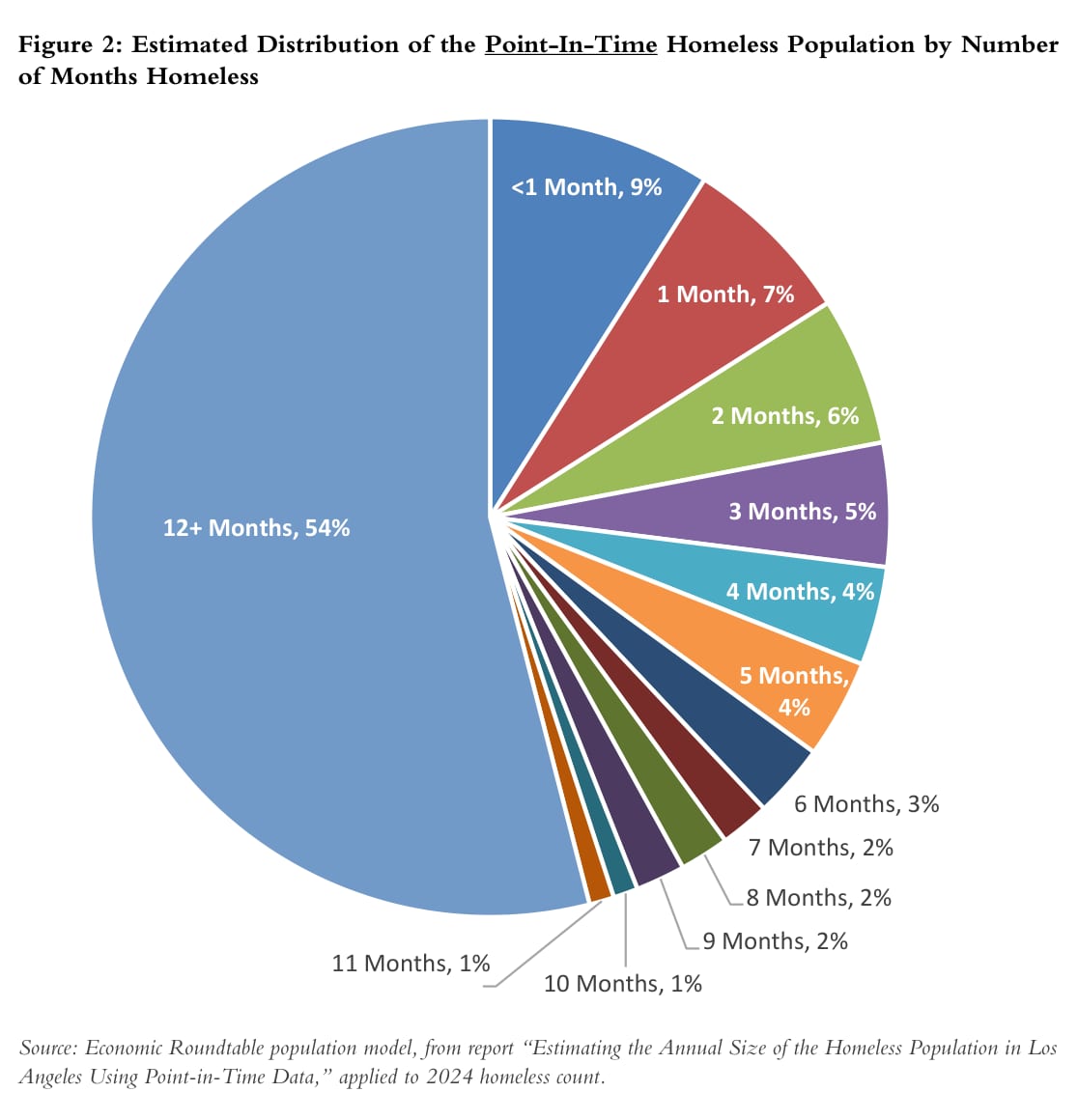
Source: Economic Roundtable population model, from report “Estimating the Annual Size of the Homeless Population in Los Angeles Using Point-in-Time Data,” applied to 2024 homeless count.
to 11 months. And slightly more than half (54 percent) have been homeless for 12 or more months.15
Total Population Experiencing Homelessness in 2024
There is annual turnover within the portion of the homeless population that is unsheltered for less than a year, so the annual population is almost twice as large as the point-in-time population – an estimated 139,151 people compared to 71,201 people in the homeless count.
The estimated distribution of the annual population based on number of months spent homeless is shown in Figure 3. Well over a third (39 percent) of the annual homeless population is estimated to have been homeless for four months or less during the past year. Twenty-four percent have been homeless for four to 11 months. And slightly more than third (35 percent) have been homeless for 12 or more months.
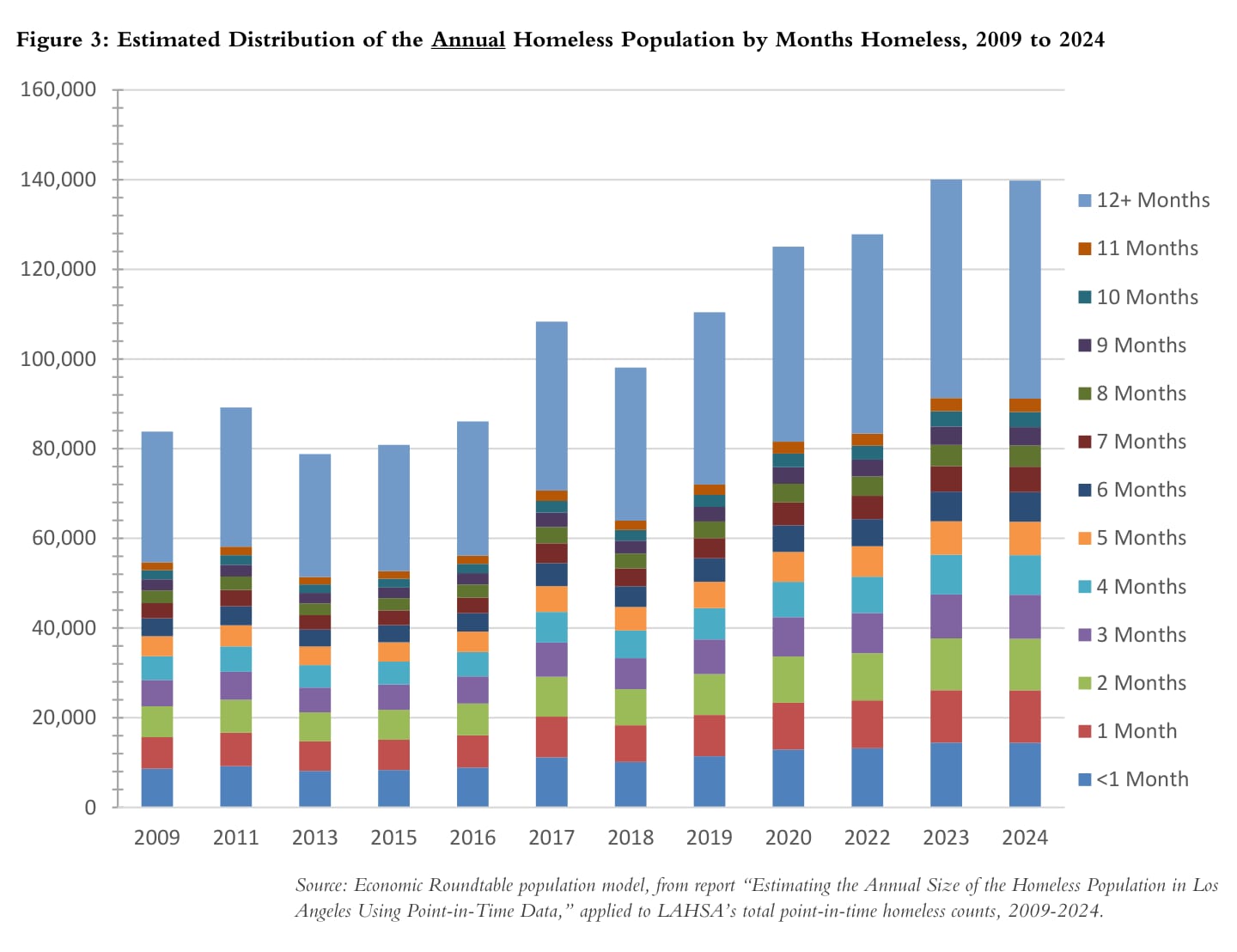
The most striking feature in Figure 3 is the population with 12 or more months of homelessness that is carried over from one year to the next. The duration of the homeless stints they report ranges from one year to 60
6 Excelling for the 2028 Olympics
Source: Economic Roundtable population model, from report “Estimating the Annual Size of the Homeless Population in Los Angeles Using Point-in-Time Data,” applied to LAHSA’s total point-in-time homeless counts, 2009-2024.
years. This is the largest, most visible and most harmed group of homeless residents.
There is a first day of homelessness for individuals who go on to become persistently homeless. There is far less social, medical and legal wreckage in their lives on the first day than there is after a year, or after 60 years, and greater likelihood that interventions less costly than permanently subsidized housing will enable them to escape homelessness.
The crucial challenges are, first, to prevent homelessness through jail diversion, shelter diversion, emergency rent assistance, landlord conflict mitigation services, employment, and income support. The second crucial challenge is to shorten the amount of time that people spend being homeless.
For example, 15 percent of unsheltered residents are estimated to be homeless for one to two years. They make up 10 percent of the total homeless population. If just this one unsheltered cohort that entered homelessness in 2023 and continued to be homeless in 2024 had been able to escape homelessness in 2023, the homeless population in 2024 would be 10 percent smaller.
Interventions that enable people to escape homelessness more quickly will have a cascading impact on shrinking the homeless population in following years. More early exits are needed for every homeless cohort.
Restorative implications: Prevent homelessness through jail and shelter diversion, emergency rent assistance, landlord conflict mitigation, landlord damage mitigation, employment, and income support. Increase early exits from homelessness through interventions such as ready access to housing choice vouchers and support services that result in stable housing. The Roundtable’s predictive screening tools were developed to support early interventions by accurately identifying individuals who are likely to be homeless for more than one year so that they can be helped before, or soon, after they become homeless rather than after long-term harm has accumulated in their lives.16
Types of Homelessness
For every one person in Los Angeles County who meets HUD’s definition of homelessness, an estimated 1.8 additional people are couch homeless.17
People fit HUD’s definition if they are sleeping in a place that is public or not meant for human habitation or a homeless shelter.18 People fit HUD’s
Source: Los Angeles Homeless Services Authority, demographic surveys 2009 to 2024, and Economic Roundtable model for estimating the distribution of types of homelessness.
8 Excelling for the 2028 Olympics
definition of chronic homelessness if they have a disability and have been homeless for 12 or more months.19
However, there are many other people who do not have a place of their own to sleep, but who find temporary shelter with accommodating relatives, friends or acquaintances. This is sometimes called couch surfing. If they do not pay any rent, we describe it as couch homelessness. Their sleeping modalities – couch, street or homeless shelter – may shift over time based on opportunity and necessity in their lives.
Some individuals live in informal housing that is affordable for them, for example, paying rent for a room in a shared housing unit. These household members are not part of the homeless population.
The annual homeless count is used in Figure 4 to estimate the point-in- time number of individuals in Los Angeles County experiencing each type of homelessness. In both 2023 and 2024, over 127,000 people are estimated to have been couch homeless because they did not have a place of their own to sleep. These individuals are part of the unhoused population that needs restorative interventions.
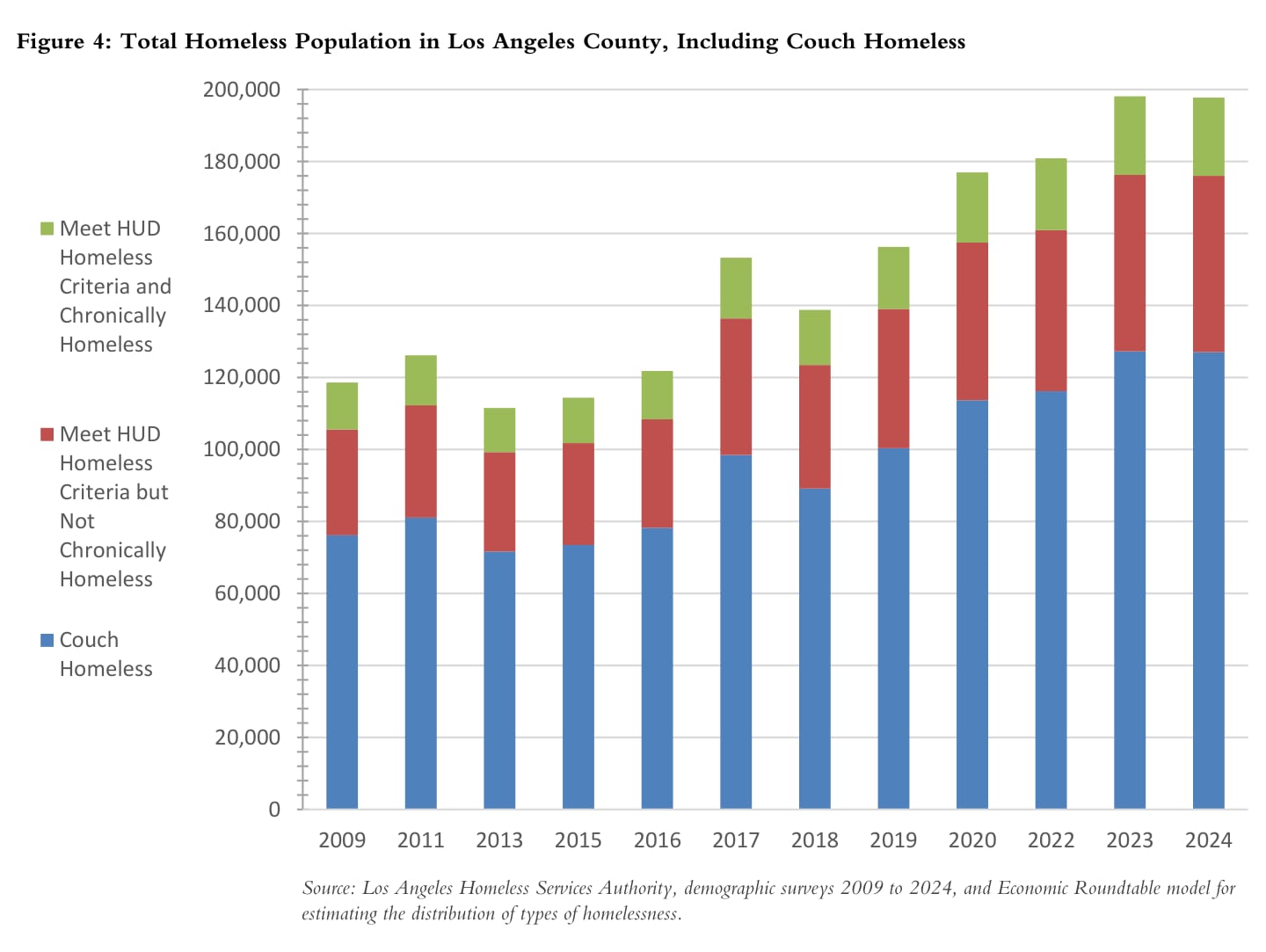
Restorative implication: The scope of homelessness is larger than the population identified in the annual homeless count. Couch-homeless individuals need employment or basic income interventions that enable them to pay rent and have a claim to housing. This includes supported employment programs and employer incentives to hire people who are unhoused or at risk for homelessness.
Reasons for Being Homeless
Homeless individuals most often explain being homeless as an economic problem. Almost half (47 percent) of unsheltered homeless adults say that the reason they are homeless is unemployment and lack of money. This factor—encompassing unemployment, lack of cash aid, acute poverty, and inability to pay for shelter—is identified roughly three times more often than any other factor as the cause of homelessness, as shown in Figure 5.
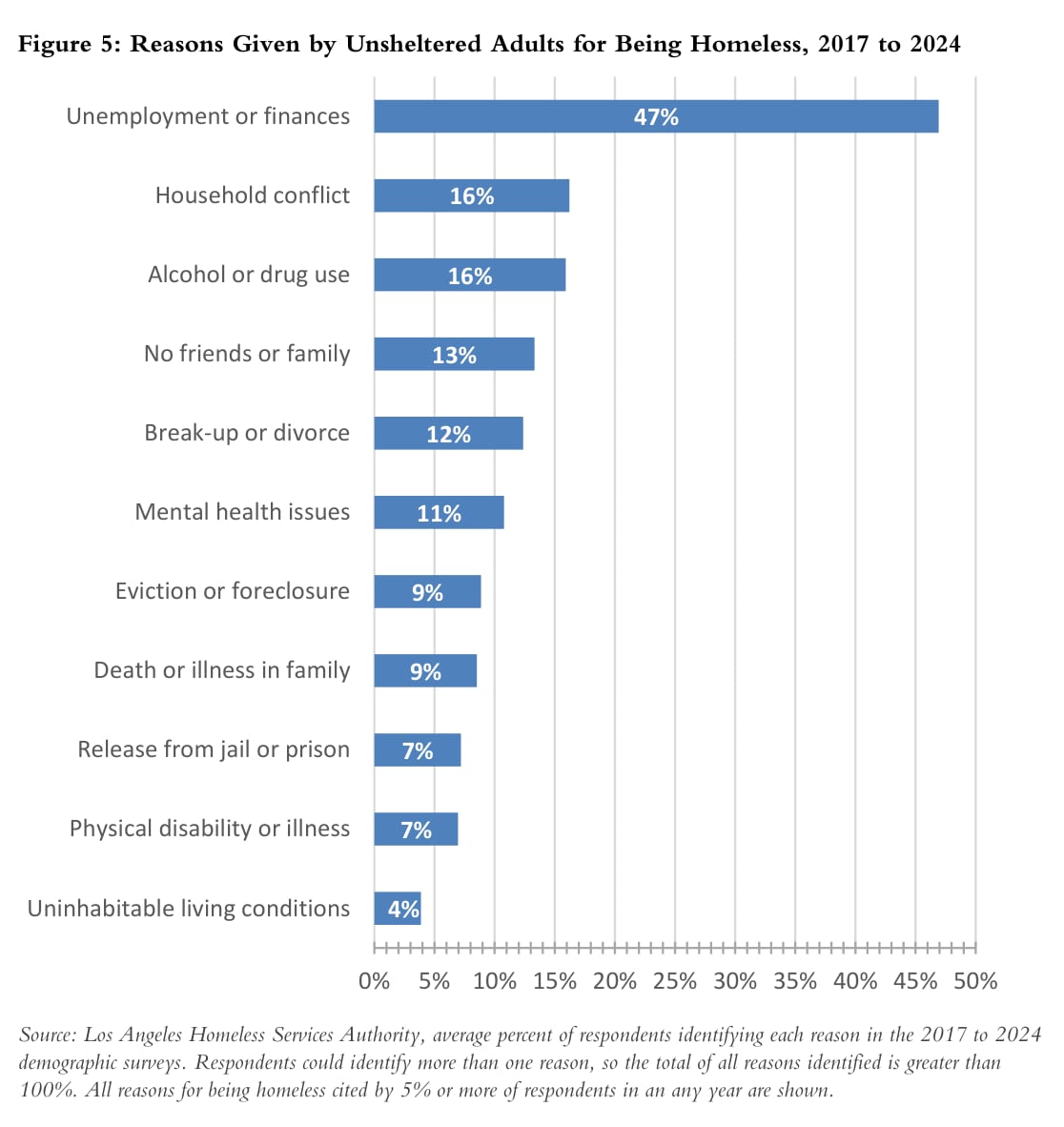
The next most frequently reported cause of homelessness is alcohol or drug use, identified by 17 percent of respondents.
Alcohol or drug abuse and mental illness are sometimes pointed to as the cause of homelessness, but only 26 percent of respondents identified one or both of these problems as the reason they were homeless. Three-quarters of respondents (74 percent) said that they were homeless for reasons other than substance abuse or mental illness.
Social disconnection–breakdown of ties with other people–is another primary reason given for homelessness. Seven reasons, cited by an
Source: Los Angeles Homeless Services Authority, average percent of respondents identifying each reason in the 2017 to 2024 demographic surveys. Respondents could identify more than one reason, so the total of all reasons identified is greater than 100%. All reasons for being homeless cited by 5% or more of respondents in an any year are shown.
unduplicated total of 36 percent of unsheltered individuals, point to loss of personal connections with other people as leading to loss of housing:20
1. Conflicts with family or household members: 14 percent
2. No friends or family available: 10 percent
3. Break-up, divorce, or separation: 9 percent
4. Death or illness of family member or child: 8 percent
5. Domestic violence, abuse, dating violence: 4 percent
6. Kicked out due to sexual orientation or gender identity: 1 percent
7. Left or aged out of foster care: 0.4 percent
Restorative implications: Greatly expand efforts to address homelessness as a problem of poverty, including help in getting a job or providing a basic income. Increase access to, and availability of, mental health and substance abuse recovery services. The interventions must achieve the basic objective of enabling individuals to have stable housing. After individuals have a place to live, service components that encourage meaningful activities, provide opportunities for part- or full-time employment, and help to build positive social support networks and community ties are needed.
10 Excelling for the 2028 Olympics
Source: Los Angeles Homeless Services Authority, responses to the homeless count demographic surveys 2015 to 2024.
First Time Homeless
The unsheltered homeless population in 2024 was made up predominantly (68 percent) of individuals who were homeless for the first time, as shown in Figure 6. This is a growing trend. In 2015, only 45 percent of the unsheltered population was homeless for the first time.
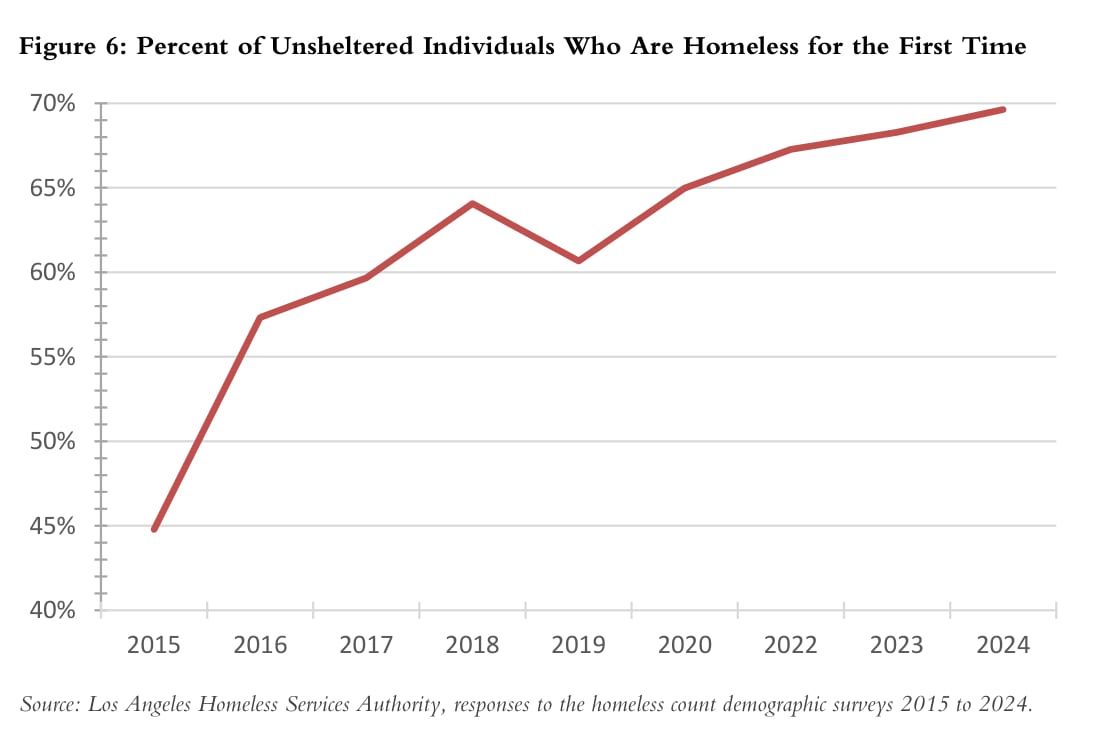
Part of the explanation for this trend may be the long-term growth in homelessness, which has meant that more people have become newly homeless each year.
Source: Los Angeles Homeless Services Authority, responses to the homeless count demographic surveys 2016 to 2024.
One explanation for why new arrivals are increasingly on the street rather than in shelters is that there are not been enough shelter beds in the communities where they were needed. Another explanation is that some shelters impose curfews, require abstinence, are inadequately managed, and feel unsafe.
Unsheltered homeless individuals have been entering homelessness at increasingly young ages.21 The average age when they were first homeless was 16 percent lower in 2024 than in 2016, 25 rather than 29 years, as shown in Figure 7. Meanwhile, the average 46-year-old age of the total unsheltered population remained almost unchanged over those years.
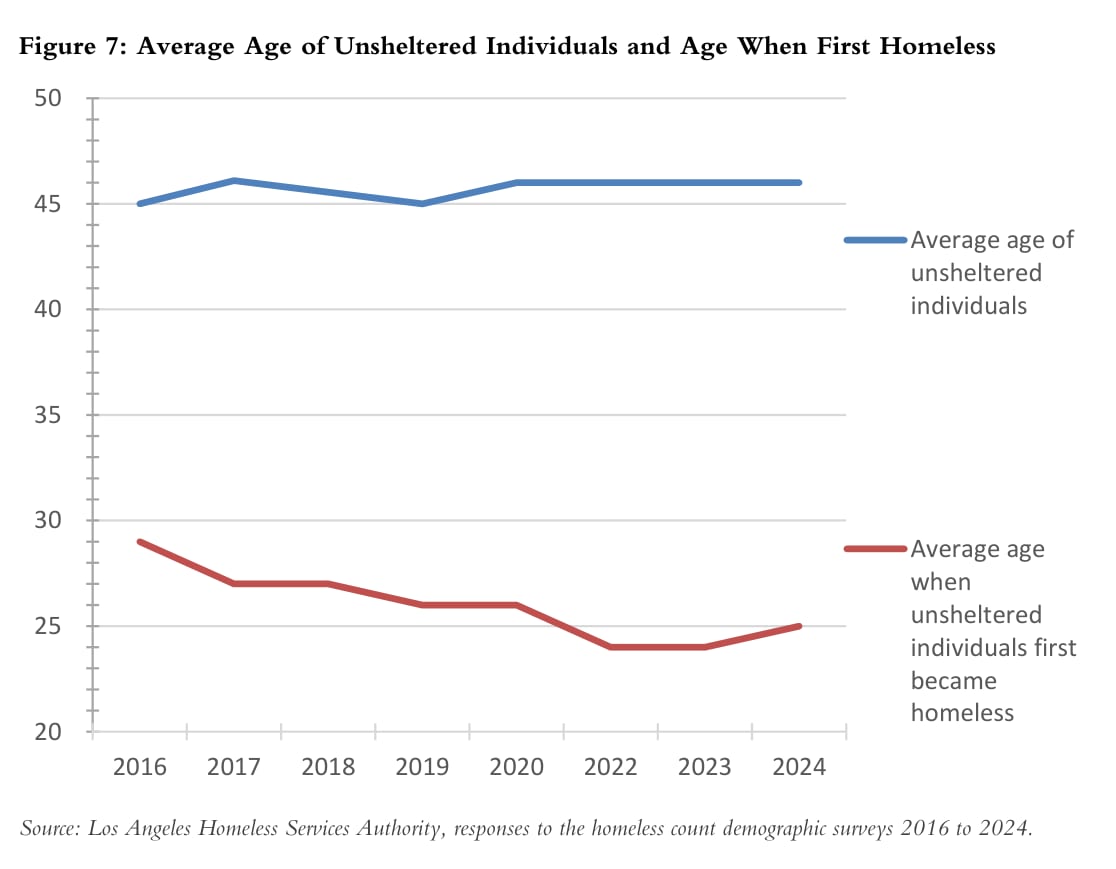
The fact that unsheltered individuals are entering homelessness at increasingly young ages, but that the average age of the total unsheltered population has remained virtually unchanged suggests the presence of an aging population whose increasing years offset the increasing youthfulness of new entrants into homelessness.
Restorative implications: New entrants into homelessness have an increasing number of potentially productive years ahead of them. Enabling them to have a basic income that stabilizes their lives, including income earned through employment, when feasible, is cost effective for the public.
Duration of Unsheltered Stints of Homelessness
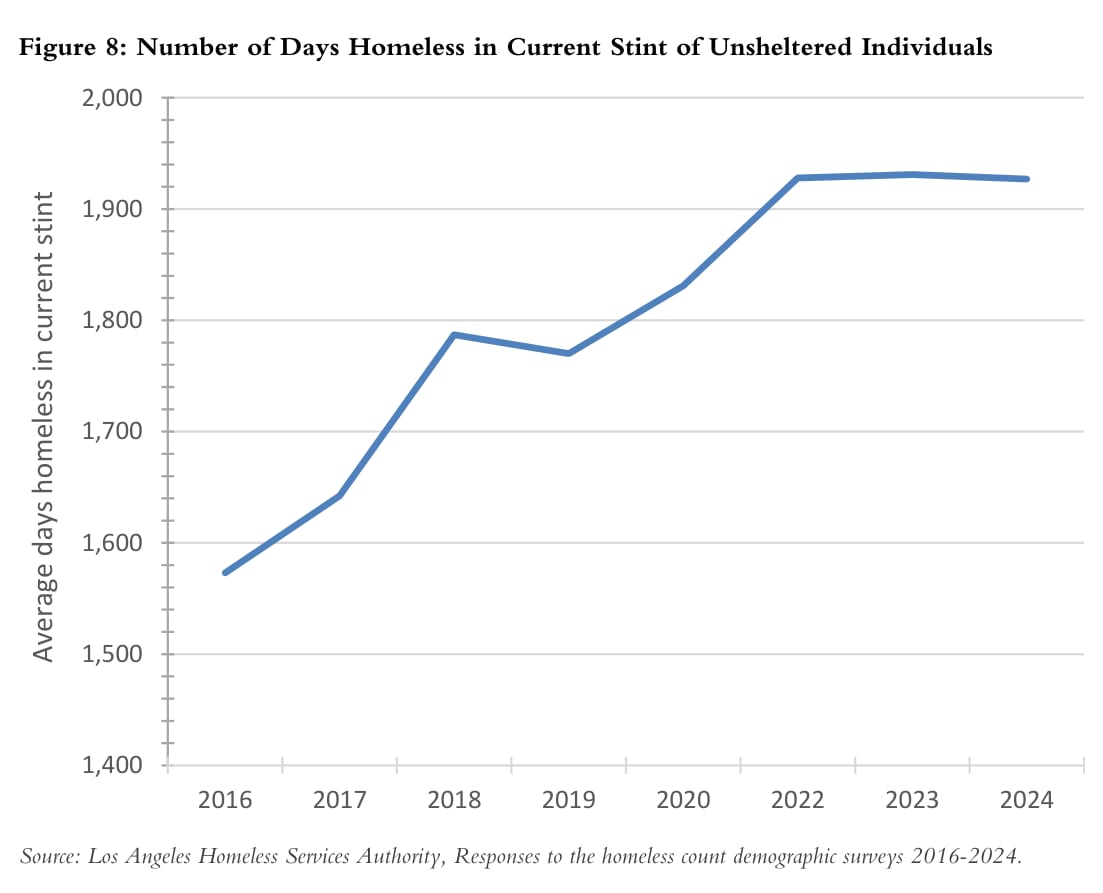
The duration of the average stint of unsheltered homelessness grew one year longer from 2016 to 2024, as shown in Figure 8.
Source: Los Angeles Homeless Services Authority, Responses to the homeless count demographic surveys 2016-2024.
12 Excelling for the 2028 Olympics
In 2016, the average unsheltered individual had been homeless 1,573 days, or 4.3 years. By 2024, this had increased to 1,927 days or 5.3 years.
Restorative implications: Protracted homelessness results in greater social isolation, more frequent medical and mental health problems, and higher public costs.22 This argues for early, restorative intervention to house, stabilize and, when feasible, employ homeless individuals.
Education
Unsheltered individuals have consistently reported significant levels of educational attainment, as shown in Figure 9. Five demographic surveys, conducted from 2009 to 2024, have asked individuals how much education they have completed.23
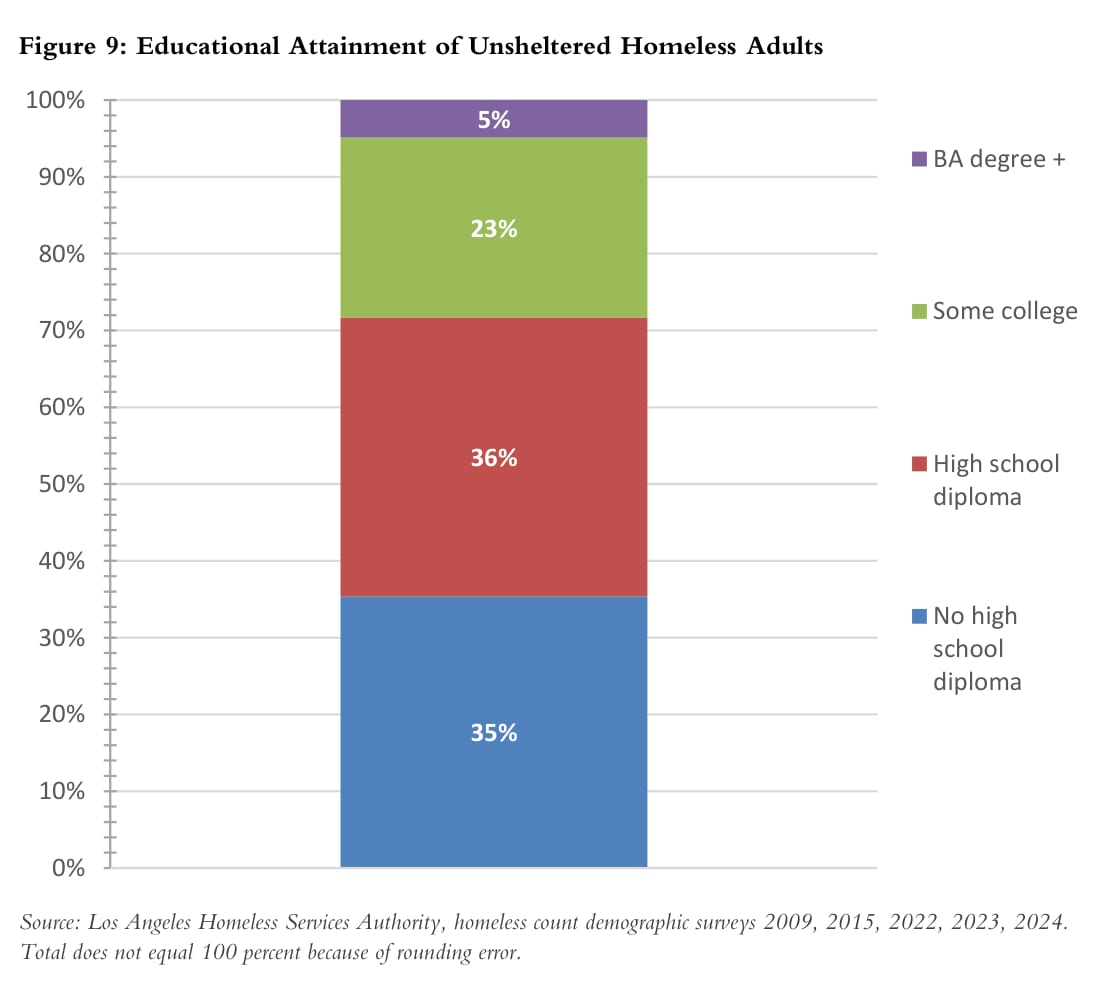
The average responses from these surveys show that 65 percent have completed high school and 28 percent have completed some college.
• 35 percent have not completed high school • 36 percent have completed high school • 23 percent have attended college but not received a B.A. degree • 5 percent have B.A. degrees
Restorative implications: There is significant human capital among unsheltered individuals. Many have the potential to be gainfully employed
Source: Los Angeles Homeless Services Authority, homeless count demographic surveys 2009, 2015, 2022, 2023, 2024. Total does not equal 100 percent because of rounding error.
if they are supported in becoming housed, recovering from trauma and stabilizing their lives.24
Justice System Involvement
Displacement through criminalization is already underway. The likelihood that unsheltered individuals will have justice system involvement has increased markedly over the past five years, as shown in Figure 10.
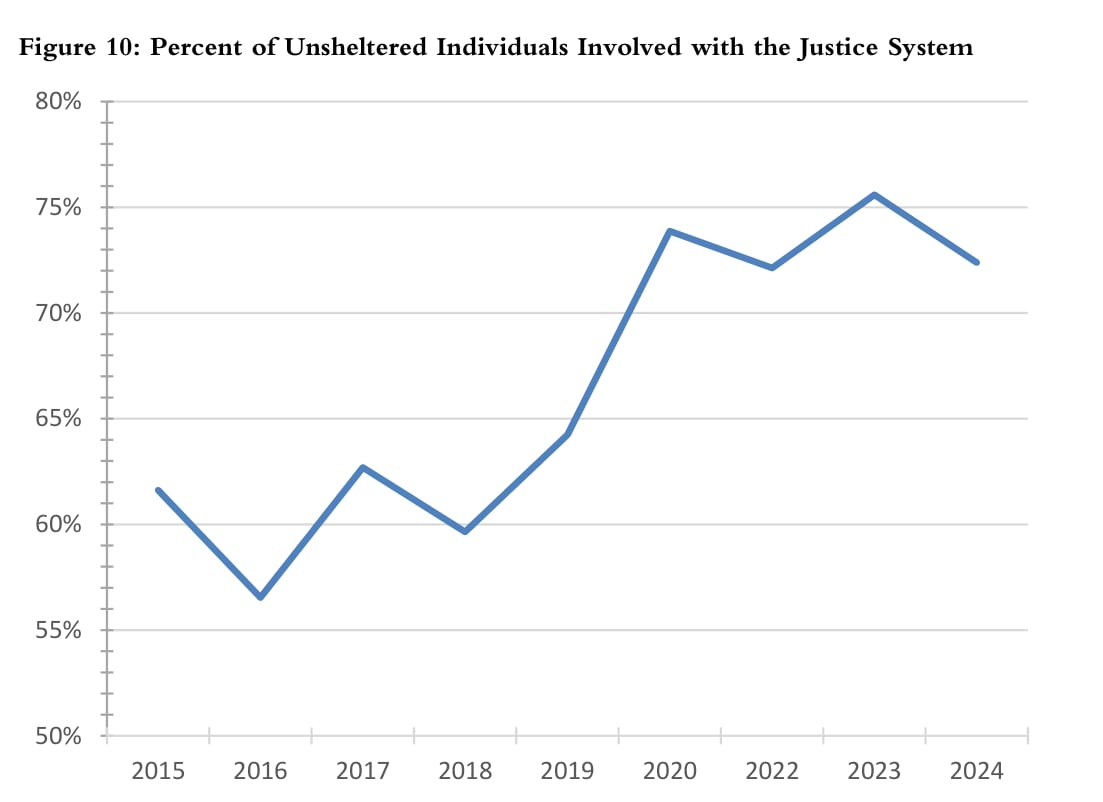
From 2015 through 2018, an average of 60 percent of unsheltered individuals reported that their history included prison, jail, adult or juvenile probation, parole, or juvenile detention. By 2020 through 2024, the share reporting justice system entanglement had increased to an average of almost three-quarters of the population, 73 percent.
An investigation by Human Rights Watch found that while homeless people make up only one percent of LA’s population, they accounted for 38 percent of all citations and arrests from 2016 to 2022.25
Restorative implications: Justice for unsheltered individuals should not be solely punitive. It should include genuine opportunities for individuals to stabilize their lives. This includes significantly expanding the District Attorney’s record expungement programs, especially for crimes related to homelessness and poverty. The presence of law enforcement in clearing encampments should be complemented by access to short-term and permanent housing, and engagement of health, mental health and substance abuse services, and case managers who can provide whole person support. Community colleges can provide training that helps individuals become more employable.
14 Excelling for the 2028 Olympics
Monthly Income
The real income reported by unsheltered individuals has been volatile, with only a small increase over the 15 years from 2009 to 2024, as shown in Figure 11. The reported median monthly income, adjusted to 2023 dollars, was $318 in 2009 and $387 in 2024.
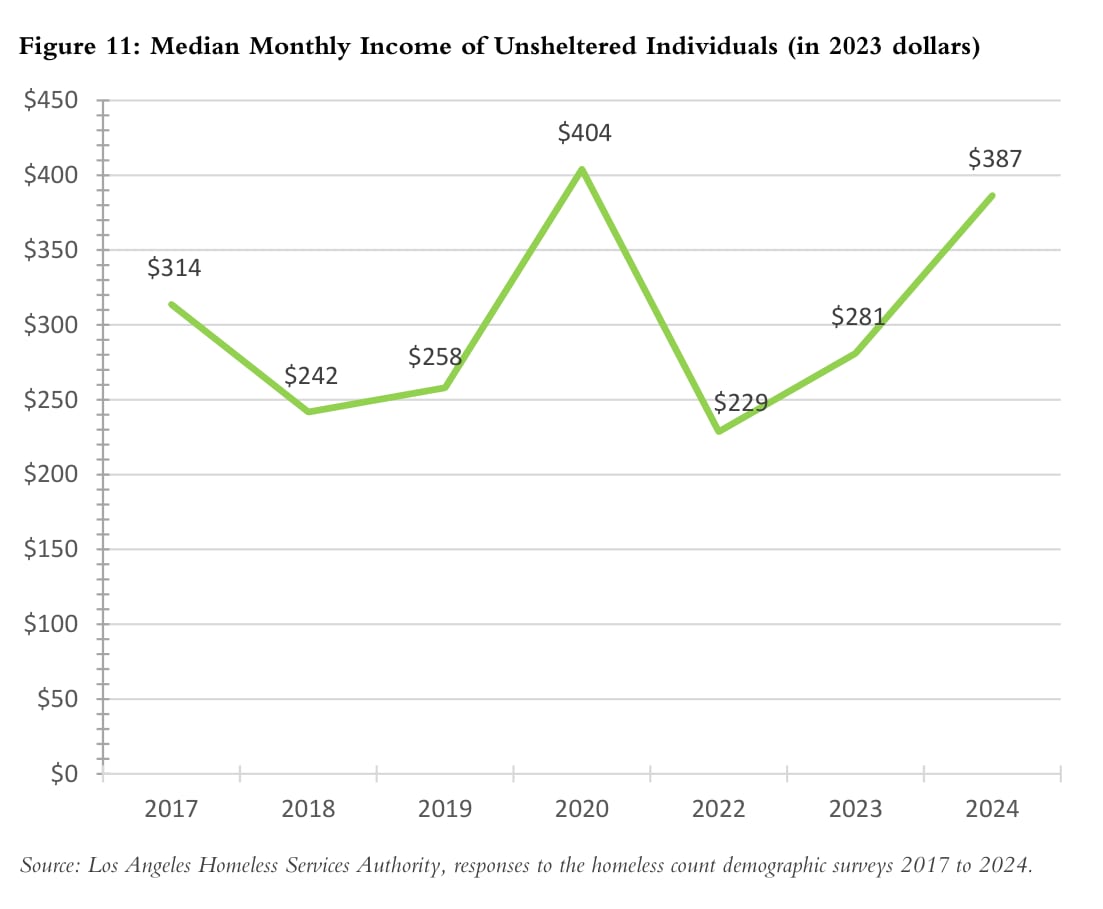
Los Angeles County’s General Relief grant of $221 a month for destitute adults is the primary source of income for many unsheltered individuals. The amount of the grant has remained unchanged since 1985.26 The consumer price index has increased 209 percent since then, and HUD’s benchmark for the fair market rent in Los Angeles has increased 346 percent.27 The steady decline in the real value of the grant is an important explanation for why Figure 11 does not show more income gains.
The brightest spot in the incomes of unsheltered individuals was in 2020, when the universal cash payments made during the Covid pandemic increased the median income of unsheltered individuals to $404 (in 2023 dollars). Incomes dropped in 2022, when the Covid payments had ended, and then increased to $387 in 2024. This income growth is a promising trend, but still far from sufficient to pay rent for any type of dwelling.
Even with the 2020 income “spike” included, the overall median monthly income of homeless individuals from 2009 through 2024 has been only $294 a month. This sub-poverty income level explains homelessness. Individuals simply do not have enough money to pay for any type of housing.
Source: Los Angeles Homeless Services Authority, responses to the homeless count demographic surveys 2017 to 2024.
Restorative implications: A basic living income is essential for escaping homelessness. Recent research at USC’s Center for Homelessness, Housing and Health Equity Research found that providing unhoused people in Los Angeles with $750 per month for just one year reduced homelessness by 30 percent.28
In addition to providing basic incomes and producing as much new housing as possible, the City and County need to look at the supply of space in the existing housing stock, both in available rental housing that can be rented using vouchers and the informal housing stock.
The informal rental network includes rooms rented in single-family homes and apartments. One way to reduce homelessness is to access this informal housing stock by giving basic income subsidies to unhoused people to help pay for it.29
Findings from the California Statewide Study of People Experiencing Homelessness provide convincing evidence about the importance of informal housing. Almost half (47 percent) of homeless individuals in Los Angeles County were informally housed before becoming homeless. Their median monthly rent was $185, with only one-quarter paying over $575.30
In the next 48 months, the City and County can increase access to informal housing by providing incentives for homeowners and leaseholders who potentially have space to sublet.
Sources of Income for Newly Homeless Individuals
Newly homeless individuals report meager sources of income. Sources reported by individuals who are homeless for the first time and have been homeless for less than one year are shown in Figure 12.